
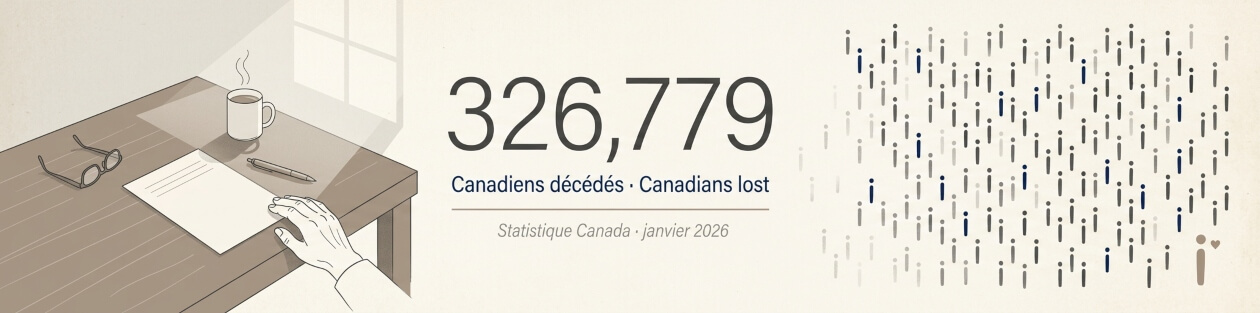
In 2024, 326,779 Canadians died. Statistics Canada released that number in January 2026. We don’t know how many of those deaths resulted in a published obituary – nobody tracks that figure. But we do know this: most families who sit down to write one have never done it before. And most are doing it during the worst week of their lives.
We built this resource to help. If you found us by searching for Canada obits or Canada obituaries, that’s exactly why this page exists. Not a template generator, not a paid service. Just a plain explanation of what goes into a Canadian obituary, what it costs, where to publish it, and how to make the text feel like the person it describes.
What an Obituary Actually Is
An obituary is a public notice that somebody has died. That’s the bare minimum. But most families want it to do more: to say something about the life, not just the death.
A death notice and an obituary are different things, though newspapers sometimes blur the line. A death notice is short: name, age, date, surviving family, service details. It runs maybe 50 words. An obituary tells a story, however brief, about who the person was. Career, interests, the town they grew up in, and the people they loved. It runs 150 to 600 words in most Canadian papers.
The price difference between the two is not small. A death notice in the Globe and Mail costs between $200 and $500, depending on length and whether you add a photo. A full obituary in the same paper can hit $4,000, one family told blogger Hugh Stephens in 2025 that their mother-in-law’s obituary cost exactly that. The Toronto Star charges $500 to $2,000+, again depending on word count and run time. Smaller regional papers charge less, often $85 to $200 for a standard notice.
That price surprises people. We’ve heard it dozens of times: “I didn’t know obituaries cost money.” They do. And the cost has been climbing.
What to Include – Section by Section
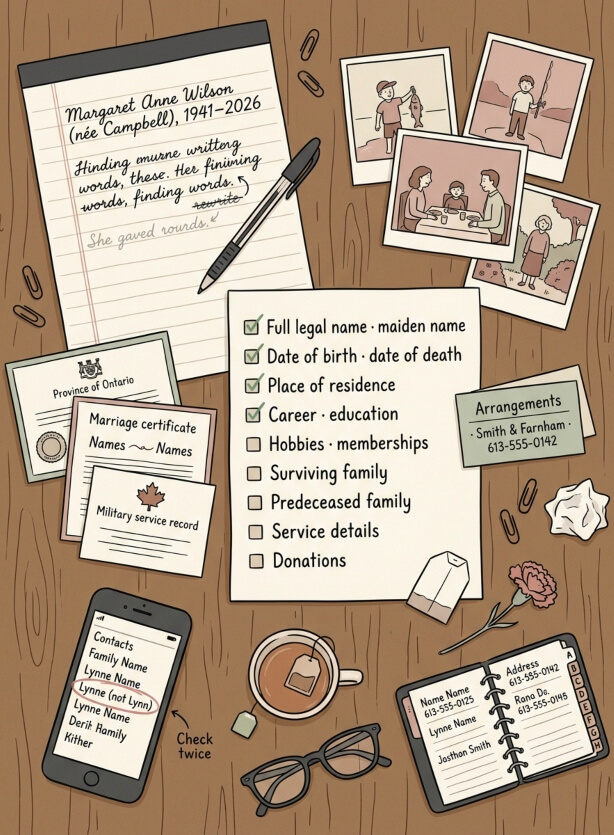
Start by gathering information before you write a single word. You’ll need:
- Full legal name, and any nicknames or maiden names
- Date of birth and date of death
- Place of death and place of residence
- Career history, education, military service if applicable
- Hobbies, volunteer work, memberships, passions
- Names of surviving family members – spouse, children, siblings, grandchildren
- Names of predeceased family members
- Details about the service – when, where, who’s officiating
- Where to send donations or flowers
Once you have the facts, choose a structure. Canadian obituaries tend to follow this order: announcement of death, a brief life story, the list of survivors, ceremony details, and a closing note about donations or charitable requests. But there’s no law that says you have to follow that sequence. Some of the best obituaries we’ve read start with a small story – a fishing trip, a recipe, a phrase the person always said – and fold the facts in around it.
One thing we’d recommend above everything else: proofread the names. Misspelled names in obituaries happen more often than you’d think, and once the paper prints it, that version lives in the Canadian obituary archive forever. If your mother’s cousin’s name is “Lynne” and not “Lynn,” that matters. Check twice.
Tone and Style – Matching the Person
There’s no single right tone. A retired RCMP officer’s obituary will read differently from a children’s book illustrator’s. And it should.
A formal tone works when the family wants dignity and tradition. A warm tone suits someone who was known for generosity or humour. A celebratory tone, which has become more common in Canada since celebrations of life started replacing formal funerals, reads almost like a toast. Pick the tone that would have made the person comfortable. Or uncomfortable in exactly the right way.
Here’s a sample opening we wrote for this page. The person is fictional:
Jean Martin, 78, of Winnipeg, died on March 12, 2026, at home, with her daughters beside her. Born in Saint Boniface to Laurent and Marie-Claire Martin, she taught French at Kelvin High School for 31 years and retired in 2009, not because she wanted to, but because her knees did. She spent her retirement gardening, reading mystery novels at a pace of two per week, and making tourtière every Christmas for a list of recipients that grew longer each year. She was not a person who liked fuss. She would have been annoyed by this obituary. But she would have read it anyway, start to finish, and corrected the grammar.
That’s 132 words. It’s enough. You don’t need 600 words to honour someone. You need the right 130.
Print vs. Online: What Changed, and When
For most of the 20th century, Canada obituaries appeared in newspapers and nowhere else. Your options were the local paper and maybe a regional daily. That was it.
Legacy.com changed that. The platform, which now hosts online obituaries for most major Canadian newspapers, including the Globe and Mail, Toronto Star, Vancouver Sun, Ottawa Citizen, and Montreal Gazette, lets families publish obituaries that aren’t limited by column inches. You can add photos. Video. A guest book where people leave messages. Donation links. The text can be updated after it runs.
And online death notices are cheaper. An online obituary costs between $50 and $100, and many funeral homes publish them for free on their own sites. If a free obituary search is what brought you here, and our analytics suggest that’s true for a lot of visitors, this is probably the most practical sentence on the page: check the funeral home’s website first.
For older records, finding Canadian obituaries online gets harder the further back you go. Pre-2000 obits are rarely digitized unless a library or genealogy project scanned them. Ancestry.ca and FamilySearch.org carry some historical death records. Newspapers.com has partial Canadian obituary archives. But for genuinely old obituaries, pre-1980, say, you’re probably looking at microfilm at a public library. The national obituary archive that most people imagine exists doesn’t, really. It’s scattered across hundreds of newspapers, funeral home sites, and platforms like Legacy.com.
We don’t have a solution for that. Nobody does, yet.
Where to Find Obituaries by Province
Every province runs its own death records registry (often called “vital statistics” in official documents). These are not the same as obituaries – they’re government records, and you typically need a reason (and a fee of $27–$45, depending on province) to request a death certificate.
For obituary searches, the fastest approach is usually the newspaper. Most major Canadian papers run obits online now, either on their own sites or through Legacy.com.
Here’s a short list to start:
- the Toronto Star and Globe and Mail for Ontario
- the Vancouver Sun and Province for British Columbia
- the Calgary Herald and Edmonton Journal for Alberta
- the Leader-Post for Saskatchewan
- the Winnipeg Free Press for Manitoba
- and the Chronicle Herald for Nova Scotia.
We’ve built separate pages for each region – Ontario, Southwestern Ontario, Toronto & GTA, Eastern Ontario, Northern Ontario, British Columbia, Alberta, Saskatchewan & Manitoba, Atlantic Canada, and Quebec – with detailed guides for each area.
What’s Changing – Celebrations of Life, Cremation, and Green Options
Canada’s cremation rate hit 76.7% in 2025, according to the Cremation Association of North America. That means roughly three out of four Canadians who died last year were cremated. In British Columbia, the rate has been above 80% for years. Prince Edward Island, historically the lowest, has caught up fast.
That shift has changed how families think about obituaries. When there’s no burial and no graveside service, when the family holds a celebration of life three weeks later at a community hall or a lakeside cabin, the obituary becomes less of an urgent announcement and more of an invitation. The timeline loosens. The tone shifts.
Celebrations of life have grown steadily since COVID-19 made traditional funeral gatherings impossible for two years. Many families who were forced into simpler ceremonies discovered they preferred them. Some funeral homes now call themselves “celebration of life centres.” The language is moving. We’ve seen obituaries that say “a celebration of Jean’s life” instead of “a funeral service” – and the text reads differently because of it.
Green burial and alkaline hydrolysis, sometimes called water cremation, are available in some provinces but still rare. CANA data puts both at about 0.1% nationally. Human composting (natural organic reduction) was legalized in some US states but isn’t yet available in Canada. These alternatives get media attention, but the numbers are tiny. For now. Canada’s first crematorium opened at Mount Royal Cemetery in Montreal in 1901. These things take time.
FAQs
Between $200 and $500 for a standard notice. Longer obituaries in major papers like the Globe and Mail can cost $2,000–$4,000. Smaller regional papers charge $85–$200.
Yes. Many funeral homes post obituaries on their websites at no charge. Legacy.com offers free basic listings alongside paid options.
Try Legacy.com, Ancestry.ca, or FamilySearch.org for recent decades. For older records, contact the local public library. Many have newspaper archives on microfilm.
A death notice states the facts: name, date, service details. An obituary adds a narrative about the person’s life.
Between 150 and 600 words cover most situations. Newspapers charge by length, so shorter can save money. Online platforms have no word limits.
No. You can submit directly to most newspapers by email or online form. But funeral homes will handle it for you – some for free, some for a fee.
CanadaObits.ca was previously operated as an online obituary directory by Brett Denning and Colin Haskett. The current website has no affiliation with the previous operators, any funeral home, newspaper, or obituary service. We created this resource to help Canadians find obituary information and learn how to honour their loved ones. Content is for informational purposes only.